Tuesday, December 16, 2014
His Eye Was Single
In Matthew 6:22, Jesus said, "The light of the body is the eye: if therefore thine eye be single, thy whole body shall be full of light." As far as the followers of Jesus go, one of the most shining examples of someone who sought to live this principle to the full is Jonathan Edwards. Edwards was born in the 18th century, and is best known as one of the chief figures of the Great Awakening, as well as the author of the famous sermon, "Sinners in the Hands of an Angry GOD".
What has been often overlooked by many of us—except perhaps those who take to write a biography of him—is that Edwards was a driven man, with only one ambition: to live for GOD's glory. Every other aspiration was subordinate to this aim, and every aspect of his life was subject to it. Jonathan Edwards' Resolutions testify to this.
For example, number 28 shows that he understood that studying the Bible every day was an absolute necessity when it came to having a healthy spiritual life. " Resolved, to study the Scriptures so steadily, constantly and frequently, as that I may find, and plainly perceive myself to grow in the knowledge of the same." Number 29 shows that he knew the importance of prayer: " Resolved, never to count that a prayer, nor to let that pass as a prayer, nor that as a petition of a prayer, which is so made, that I cannot hope that God will answer it; nor that as a confession, which I cannot hope God will accept." The following resolution, number 30, clearly shows that he sought to attain to greater heights in his relationship with GOD. "Resolved, to strive to my utmost every week to be brought higher in religion, and to a higher exercise of grace, than I was the week before."
Edwards wasn't just concerned with religion in terms of a life of mere devotional thought and exercise. He determined to bring the Bible into his everyday life. This included the wise management of his time. "Resolved, never to lose one moment of time; but improve it the most profitable way I possibly can."[1] Even appetite did not escape his scrutiny, as is evidenced by the 20th resolution: Resolved, to maintain the strictest temperance in eating and drinking."
Naturally, these encompassed not only Edwards' conduct towards himself, but towards others. Three of the seventy resolutions deal with the way he ought to speak to people[2], number 46 specifically addresses his attitude in regards to the members of his family— particularly his mother and father[3], and two others pertain to issues that relate to his fellowmen, albeit indirectly.[4]
Someone once said, "Bible religion is not one influence among many others; its influence is to be supreme, pervading and controlling every other. It is not to be like a dash of color brushed here and there upon the canvas, but it is to pervade the whole life, as if the canvas were dipped into the color, until every thread of the fabric were dyed a deep, unfading hue."[5] We have no doubt seen that this is certainly true of Edwards. His religion influenced his life through and through. You truly cannot know anything about Jonathan Edwards without knowing of the other. Indeed, the two are so thoroughly intertwined that it is well nigh impossible to separate the man from his beliefs. In other words, they were one. His eye was single.
While he did not have all the light that we do today, Jonathan Edwards was a faithful steward of the truth which he did have, and I believe that he will rise again when Jesus returns. I believe that GOD allowed this man to live not only to bless those in his day, but also to be a blessing to us through the example that he left behind. I know that this has been the case with me, and it has made me want to more fully consecrate myself to the service of the Saviour. May we all seek, as he did, to let our eye be single to the glory of GOD.
Blessings,
Jean
Sunday, December 14, 2014
It's What We Do Today
Neither did the royalty of France escape the influence of his conversion. Francis I and his sister Margaret were his friends, and he sought to share the joy he had discovered with them. As he heard the bishop speak, the king was aware of something of what the gospel could do for his countrymen; but for whatever reason, he cast his lot on the side of Rome in the end. Margaret, however, found Jesus to be the Friend she had searched for, the One who could dispel the heaviness in her heart.
Afterwards, Briconnet continued to labor to bring others to the Saviour, and as Lefevre and others joined him in Meaux, the place became renowned throughout the country for its spirituality. If one was inclined to Protestantism, it was said that he had "drunk at the well of Meaux." Sooner or later, persecution began, as always happens when the Bible gains a strong foothold. Then the bishop was faced with an ultimatum: either recant or burn at the stake. Sadly, he chose the former, and never looked back.
The bishop wasn't the only one to fall. Another was Pavane, a gentle youth who possessed great love for GOD, and who worked to help his friends find Him. "The virgin Mary can no more save you than I can.There is but one Saviour, Jesus Christ," he explained to them. It was this statement that led to his arrest. He was commanded to publicly renounce his statement, and if he refused, he was to suffer the same fate that Briconnet would have.
Like the bishop, Pavane shrank from being a martyr, and agreed to their demand. Christmas Eve, 1524, found the lad walking barefooted and bareheaded through the streets, with a rope around his neck and a candle in his hand, to the cathedral of Notre Dame. Once there, he asked forgiveness of Mary for having spoken against her. Afterwards, Pavane was brought back to his dungeon; but he was now in a darker place than that cell. He couldn't remember the comforting Scriptures he had read, and he couldn't alleviate the tremendous trouble that now afflicted his soul.
In contrast to Briconnet, the youth decided, "I would rather go a hundred times to the stake, than to drink this bitter cup!" With tears, he confessed his sin to GOD, and resolved to forsake it. Stake or no stake, he would be faithful to his Saviour. His end came quickly, but he faced it courageously, happy that nothing could take him from Jesus now. It appears that Pavane was able to witness for Him before the flames extinguished his life, for a doctor from the Sorbonne later commented to his associates that "It would have been better for the Church to pay millions in gold than to allow that young man to speak."
We are not to be concerned in regards to having the strength to be a martyr unless we are in that situation. GOD only gives us enough grace for the day (2 Corinthians 12:9). However, we need to realize that it is what we do each day that determines what we will do in the future. Our Saviour bid us "Watch and pray, that ye enter not into temptation: the spirit indeed [is] willing, but the flesh [is] weak" (Matthew 26:41). Somewhere along the way, the bishop and the boy were lax in this matter, and so paved the way for their denials. If we too fail to always follow this command, we begin to walk the road that will, in the end, lead us to follow the sad examples of the men we read about--and we may not be able to escape as Pavane did. After all, it's what we do today that determines what we will do tomorrow.
Blessings,
Jean
Note: See J.A. Wylie's The History of Protestantism for the accounts of these men.
Monday, December 8, 2014
Letters and Liberality
*Lily* knew *Ryan* went to her church occasionally, but aside from that, she knew little else except that he was younger than she was. She decided to get to know him, and wrote him a letter. She didn't receive a reply, but that was because Ryan's mother said he had lost the envelope. "All right," Lily said with a smile. "I'll write him another one!" She started to, but never finished it. Weeks went by, then months, and finally a year. Lily felt terrible, especially because of what she had said she would do. She purposed to begin her endeavor anew, and wrote to Ryan apologizing for not sending him another one sooner. Lily then decided to write him a letter every month. No letters came to her for quite some time, but she was cheered by the thought that maybe she was adding a bit of happiness to someone's day. Then, after seven months of doing this, a letter from Ryan arrived! It wasn't that long ago that this took place. I am happy to report that since then, he and Lily have been communicating quite regularly.
Paul says in 2 Thessalonians 3:13: "But ye, brethren, be not weary in well doing." Why could he say that? The apostle knew from personal experience that fruit from such labors did not always always come speedily, and some might be tempted to give into discouragement. If your efforts to be friendly, to do good to someone, seem futile, don't stop! Someday you'll see that it wasn't in vain. Perhaps it won't be in the same way that Lily saw with Ryan, but you will see it--if not here, then in eternity. That is certain. Besides, you will find that there is joy in giving, even if it isn't acknowledged.
Even if nothing were to come of it with others--though that is impossible--, it won't have been in vain for you. All along the way, you will have cooperated with the Master as He sought to teach you the lessons of unselfish love and labor, and thus reaped many a blessing in terms of character-building. As it says in Proverbs 11:24: "The liberal soul shall be made fat: and he that watereth shall be watered also himself." Paul affirmed this when speaking to the church about giving funds to spread the gospel. He wrote, "But this [I say], He which soweth sparingly shall reap also sparingly; and he which soweth bountifully shall reap also bountifully" (2 Corinthians 9:6). Are these words true, not only concerning money, but also love and kindness? I think so. If we work with Jesus to uplift those around us, He will be the more able to uplift us; but if we do nothing for our fellow men, or if we give up because it seems too hard, how can He help us? Not only will those around us suffer because of our selfish stinginess in that case, but so will we. Our characters will become so narrow because we won't think of anyone but ourselves that Christ will have no room to work with us--and we know what that results in!
Let us be liberal, then, not caring whether the visible returns are great or small. There is too much else at stake for us to do otherwise.
Blessings,
Jean
Tuesday, December 2, 2014
The Furry Four is No More
Well, Lacey was also a corgi, and my dad fell in love with her. At the time, we lived in Massachusetts, and she was in Delaware, but that didn't matter to him; he drove all the way down there to get her and back. While it was a new and difficult experience caring for her at first, we grew to love her. Two years later, we rescued Friday. In hindsight, that was a mistake. There was a change in Lacey. She became more protective of her food (previously she would leave it all day, and only eat at night), and more nervous. Even so, the change didn't seem to be that serious, and we continued on as normal. Over the next few years, we had hamsters and cats. With each new animal, she became more and more nervous, but we thought it was more or less all right, because by the time it was just Friday, Lacey, and Kitty, they had all come to an understanding of sorts, and they all loved each other in their own way, even though they annoyed one another. Lacey and Fluffy weren't well acquainted (mostly Fluffy's choice). Recently, however, she had tried to attack Friday and Kitty.
Along with her declining emotional state, there was her declining physical state. Lacey struggled to move around these past few months, often falling when trying to stand up or walk. She was resting more and more, with only spurts of energy here and there.
The looming threat of her harming someone or something, and her obvious physical discomfort, are what made us decide to put her down today. Mom and Dad went with her, while Z. and I stayed here. Apparently it didn't take long at all, and she was happy all the way through.
What made me sad more than her being gone--I know it was the best thing--is the fact that she was even disabled and had to die. Nothing was ever meant to suffer or to die. GOD never meant for us to know that. I don't know if I will see her again; the Bible neither affirms nor negates pets being in heaven, but even so, the whole tragedy made me long for that day "when this corruptible shall have put on incorruption, and this mortal shall have put on immortality, then shall be brought to pass the saying that is written, Death is swallowed up in victory" (1 Corinthians 15:54). How about you?
Blessings,
Jean
Thursday, November 27, 2014
Klaus and Michael: A Story of Persevering in Prayer
Klaus-Dieter John and Michael were best friends, and both Christians. Michael hadn't always been, but he had happily given his heart to the Saviour after attending church with Klaus. At the advice of Klaus' father, Michael had begun reading his Bible regularly afterwards. Unfortunately, Michael's hot-tempered mother found out, and forbade him to associate with Klaus at all. It didn't help that the Johns were not members of the state churches, but rather a Baptist minority. Michael's mother was convinced that her son would return to "normal" if only he stayed away from Klaus and his family. Michael sadly related his mother's decision to his friend as they walked home from school one afternoon.Naturally, this disheartened Klaus, but he didn't sink into despondency over it. Instead, upon reaching home, he went into his room and closed the door. Grabbing his Bible, he read its interpretation of Luke 18:1-8. The KJV renders it this way:
"And He spake a parable unto them [to this end,] that men ought always to pray, and not to faint; Saying, There was in a city a judge, which feared not GOD, neither regarded man: And there was a widow in that city; and she came unto him, saying, Avenge me of mine adversary. And he would not for a while: but afterward he said within himself, Though I fear not GOD, nor regard man; Yet because this widow troubleth me, I will avenge her, lest by her continual coming she weary me. And the Lord said, Hear what the unjust judge saith. And shall not GOD avenge His own elect, which cry day and night unto Him, though He bear long with them? I tell you that He will avenge them speedily. Nevertheless when the Son of man cometh, shall He find faith on the earth?"
After reading, Klaus kneeled down and prayed, telling GOD that this passage said that He heard people's prayers, and that he was asking GOD to change Michael's mother's mind so that he and Michael could hang out together like before.
For two days, there seemed to be no change. Michael now took a different way home so as to avoid him, and Klaus didn't see him anymore, but that didn't deter Klaus; whenever he thought of it, he would pray and remind GOD of what He had said. On the third day, Michael was running to meet up with Klaus. All smiles, he said that his mother had told him to never mind about what she had said--he and Klaus could be friends once more!
Klaus was overjoyed, and as I read this account*, so was I. GOD does answer prayer, so long as we have persistence and faith. It should be noted that we can only gain these by waiting, and that is why, though GOD is more willing to answer us than the judge was the widow, He does not do so instantly. It is for our own good that we must do this. And so, no matter how dark things look, don't give up! It may take three days, three weeks, three months, even three years, but if we keep on trusting and following Him, Jesus will answer our prayers in the best way possible--and in the meantime, we will receive the additional blessing of character refinement!
Blessings,
Jean
*Read it for yourself in Klaus-Dieter John: Hope in the Land of the Incas by Janet and Geoff Benge.
Monday, November 24, 2014
Prideful Pilate
Pilate was not only pliable, but also prideful. That pride was in part what kept him from discovering for certain the answer to his age-old question, "What is truth?" (John 18:38). When Pilate questioned Jesus as to whether He was a king, Jesus asked him: "Sayest thou this thing of thyself, or did others tell it thee of Me?" (v. 34).
"The Spirit of God was striving with Pilate. The question of Jesus was intended to lead him to examine his own heart more closely. Pilate understood the meaning of the question. His own heart was opened before him, and he saw that his soul was stirred by conviction. But pride arose in his heart, and he answered: 'Am I a Jew? Thine own nation and the chief priests have delivered Thee unto me: what hast Thou done?' Pilate’s golden opportunity had passed." The Story of Jesus, pg. 126.
That wasn't the only opportunity. After Pilate's inquiry, the Saviour went on to explain the nature of His kingdom, which made the governor again ask if he were a king. "Jesus answered, Thou sayest that I am a king. To this end was I born, and for this cause came I into the world, that I should bear witness unto the truth. Every one that is of the truth heareth My voice" (v. 37).
"Pilate had a desire to know the truth. His mind was confused. He eagerly grasped the words of the Saviour, and his heart was stirred with a great longing to know what the truth really was, and how he could obtain it. He asked Jesus: 'What is truth?'" Ibid., pg. 126.
The Bible tells us that after he asked Jesus, Pilate returned to the scene of tumult. He never knew what Jesus would have said. If he hadn't resisted the first time, he would have known the answer. Thankfully, we can know it. In the previous chapter, verse 17, He said, "Sanctify them through Thy truth: Thy word is truth."
And yet, how many of us refuse the answer, even though it's right in front of us, for the very same reason Pilate missed his golden opportunity? How many of us refuse that which could give us life because it doesn't flatter us, because it doesn't mesh with our plans? All of us have been there at some point, to some degree; there's no denying it. Some, however, have admitted that this is indeed the truth, and submitted to it--though it hurts, in more ways than one. The result? They have found it to be their "shield and buckler", as the psalmist said they would (Psalm 91:4). May we all choose--initially and continually--to see past our pride, and grasp the truth with mind and heart! We will not be disappointed.
Blessings,
Jean
Monday, November 17, 2014
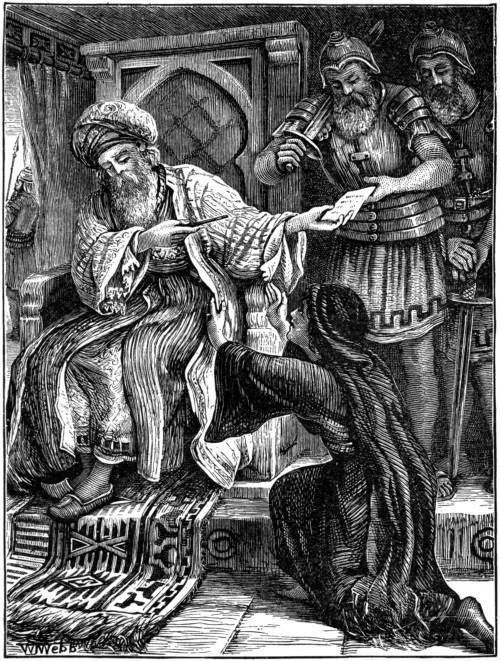
Pliable Pilate
We all know that Jesus was crucified at the command of the Roman governor, Pontius Pilate. Yet how many of us realize that there is a lesson for everyone in this man's decision? Yes, a lesson for you and me.In the morning, the chief priests and the elders took Jesus to Pilate and falsely accused Him before the governor, saying that Jesus had said to not give tribute to Caesar. Pilate was amazed that Jesus had nothing to say for Himself when it came to the charges laid against Him. After Pilate examined Jesus in the judgment hall, he returned to the people and said, "I find in Him no fault [at all.]" (Matthew 27:1; Luke 23:2; Matthew 27:12-14; John 18:38).
Pilate knew that Jesus was innocent, and that the people had brought Him there, not for any just reason, but because they envied Him (Matthew 27:18; Mark 15:10). After declaring that he believed Jesus to be guiltless and then finding out that He was a Galilean, Pilate sent Him to Herod, who had jurisdiction of Galilee. Herod couldn't find anything by which to convict Jesus as a criminal either, and had Him returned to Pilate (Luke 23:6-11).
"And Pilate, when he had called together the chief priests and the rulers and the people, Said unto them, Ye have brought this Man unto me, as one that perverteth the people: and, behold, I, having examined [Him] before you, have found no fault in this Man touching those things whereof ye accuse Him: No, nor yet Herod: for I sent you to him; and, lo, nothing worthy of death is done unto Him" (Luke 23:13-15).
Once again, Pilate asserts that Jesus has done no wrong; but then, the fateful words: "I will therefore chastise him, and release [Him]" (v. 16). "Here Pilate showed his weakness. He had acknowledged that Christ was innocent; then why should he punish Him? It was a compromise with wrong. The Jews never forgot this through all the trial. They had intimidated the Roman governor, and now pressed their advantage until they secured the condemnation of Jesus." Ellen White, The Story of Jesus, pg. 133.
So it was. From then on, the more Pilate sought to release Christ, the more adamant the Jews became in seeking His crucifixion. Eventually they cried, "If thou let this man go, thou art not Caesar's friend: whosoever maketh himself a king speaketh against Caesar" (John 19:12). "This was touching Pilate in a weak place. He was already under suspicion by the Roman government, and he knew that a report of this kind would be his ruin." Ibid., pg. 137.
The governor tried to escape from sentencing the Saviour by literally washing his hands of the matter (Matthew 27:24). "In vain Pilate tried to free himself from the guilt of condemning Jesus. Had he acted promptly and firmly at the first, carrying out his convictions of right, his will would not have been overborne by the mob; they would not have presumed to dictate to him. His wavering and indecision proved his ruin. He saw that he could not release Jesus, and yet retain his own position and honor." Ibid., pg. 137.
Pilate was pliable, and a lover of his rank and reputation more than a lover of right. He could not hold on to both; he must choose, and sadly he decided to surrender the latter in favor of the former. "But in spite of his precautions, the very thing he dreaded afterward came upon him. His honors were stripped from him, he was cast down from his high office, and, stung by remorse and wounded pride, not long after the crucifixion he ended his own life." Ibid., pg. 137.
"No man can serve two masters: for either he will hate the one, and love the other; or else he will hold to the one, and despise the other. Ye cannot serve God and mammon." "For whosoever will save his life shall lose it: and whosoever will lose his life for my sake shall find it. For what is a man profited, if he shall gain the whole world, and lose his own soul? or what shall a man give in exchange for his soul?" (Matthew 6:24; 16:25).
We have seen what happens when one allows himself to be swayed this way and that by those around him, when he tries to have the best of both worlds; he meets with total loss--temporally and spiritually. May we learn from the life of Pilate, and choose, not to be pliable or pleasure-loving as he was, but completely unyielding where the truth is concerned--even willing to give up all that the world has to offer for its sake! In so doing, we will gain what can never be lost.
Blessings,
Jean
Subscribe to:
Posts (Atom)